


Significance
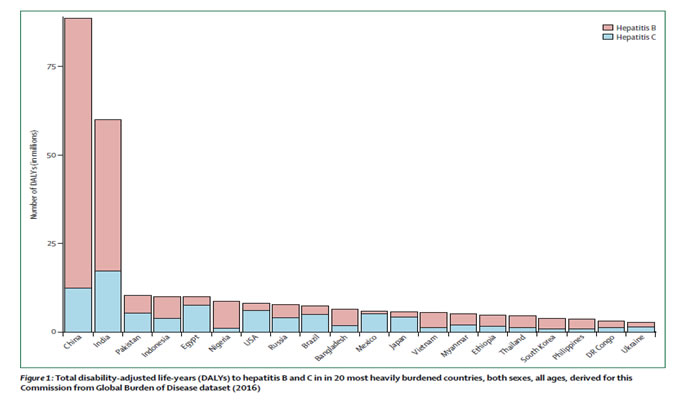
Viral hepatitis is the leading cause of liver disease, cirrhosis and liver cancer in Pakistan. In 2016, more than 75% of the global burden of hepatitis and its related diseases was shouldered by only 20 countries (figure 1). Pakistan has the second highest prevalence of Hepatitis in the world (one-tenth of the global HCV burden). There are 12 million people in Pakistan affected by Hepatitis B & C and every 30 second one person in our region dies from Hepatitis which is 3x higher than HIV/AIDS. Hepatitis C epidemic is one the biggest healthcare challenge facing Pakistan.
Most of the patients with HCV in Pakistan are asymptomatic and unaware of their infection.There is an increased in the rate of viral hepatitis-related hospitalization with rising cost. These costs and complications can be prevented or mitigated by early detection and treatment, yet many people only learn of their HCV infection after presenting with complications such as cirrhosis and liver cancer. Due to multiple breakdowns in the care cascade, only a small fraction of infected individuals have been cured worldwide.
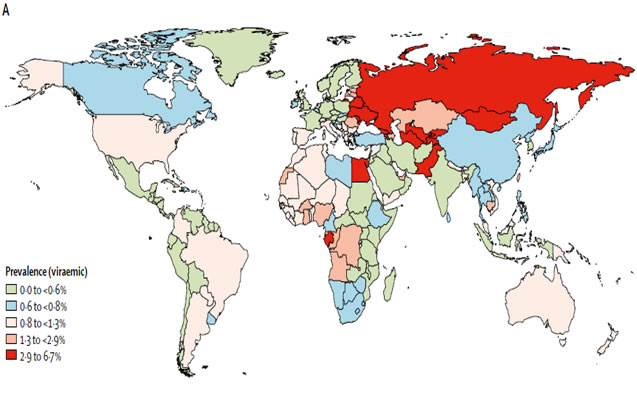
Elimination of viral hepatitis will require a shifting emphasis from a focus on individual patients to an emphasis on a coordinatedpublic health approach to interruption of transmission and infection through prevention and treatment. In the short term, this will require simplified, standardised packages of interventions that can be delivered at scale. In 2018, more people were infected with HCV than were cured.
In 2016, WHO adopted its Global Health Sector Strategy (GHSS) for viral hepatitis, which outlines an ambitious agenda for the global elimination of viral hepatitis as a public health threat by 2030, including a roadmap toward elimination and key prevention and treatment interventions aimed at strengthening health systems within the context of the universal health coverage framework. To achieve the WHO targets for elimination of viralhepatitis—namely a 90% reduction in new infections and a 65% reduction in deaths attributable to viral hepatitis by 2030—efforts need to be sustained and Pakistan need major help.
APGNA (Association of Pakistani-Descent Gastroenterologist of North American Descent) is in the process of launching its website and membership drive. Our group has so far more than 100 GI physicians. One of our main objective of our group is to work with APPNA and broaden the vision of APPNA HCV initiative. APPNA HCV initiative was started many years back (need year) focusing on education and awareness of HCV in Pakistan. The team worked impressively for many years. With the changing landscape of HCV in Pakistan our goal is to diversify objectives of this initiative. APGNA will able to bring expertise, leadership and ideas from the HCV experts.
Innovation and Ideas
This new initiative will be innovative in multiple ways. The goal is to have different teams under one umbrella to work on prevention, education, awareness and treatment of HCV. The areas we want to work on are below:
- Expertise and Leadership: Bringing experts from multiple fields beside GI and Hepatology. The goal is to have leaders from US and Pakistan working together. We are already working with liver societies in Pakistan including PSH and PSSLD. Working with them will provide us with local expertise and challenges. AASLD (American Association of Study of Liver Disease) has also shown interest in working in Pakistan for HCV eradication programs. APPNA can bring all these societies as well as government and local health care departments together.
- Prevention: One of the main focus of this team and sub-committee will be to work with leaders in Pakistan about prevention of HCV. Last year same number of new cases of HCV were added as were cured. This is a major issue and we are planning to work on many different avenues.
- 1. Education: New campaigns with Pakistani societies about HCV awareness all year long. Utilizing print and social media. Working with school and colleges.
- 2. Government: Using our connections so that we can bring public and government sectors together for this cause.
- 3. Religious leadership participation.
- 4. Working with high risk groups of transmission including polysubstance drug user, prison and barbers.
- 5. Working with blood banks, dialysis units and endoscopy units, clinics to decrease spread of HCV.
- Media Campaigns: One of the areas we wanted to focus is to start a large-scale media campaign with the help of celebrities, media houses and politicians.
- Treatment and Management: Goal is improveHCV care cascade and decrease barriers to HCV treatment in villages and rural areas.
- 1. Development of easier algorithms for primary care treating HCV
- 2. Micro-elimination projects with the focus of eradicating HCV in small areas at a time.
- 3. Access to rapid screening and diagnosis of HCV
- 4. Investing in online teaching programs like Project ECHO to educate providers in Pakistan.
- 5. Collaboration with non-profits in Pakistan with goal to sponsor HCV patients for treatment.
- Team Members from APGNA:

- 1. Dr. Bilal Hameed. San Francisco, CA
- 2. Dr. Arif Muslim, New York, NY
- 3. Dr. FasihaKanwal. Houston, Texas
- 4. Dr. Ashfaq. Dallas, Texas
- 5. Dr. Khalid Mumtaz. Columbus, OH.
- 6. Dr. Aijaz Ahmed, Palo Alto, CA
- 7. Dr. Ghulam Mujtaba, Las Vegas, NV
(Plan is to add new members and anyone interested to participate)
- Pakistani Societies:
- 1. PSG (Pakistan Society of Gastroenterology)
- 2. PSSLD (Pakistan Society for Study of Liver Disease)
- 3. PSH (Pakistan Society of Hepatology)
- Advisors in USA:
- 1. Dr. Norah Terrault
- 2. Dr. Anna Lok
- Non-profits in Pakistan:
- 1. The Health Foundation (THF)
- 2. Bilqees Razia Trust
0
Donations
0
Members
0